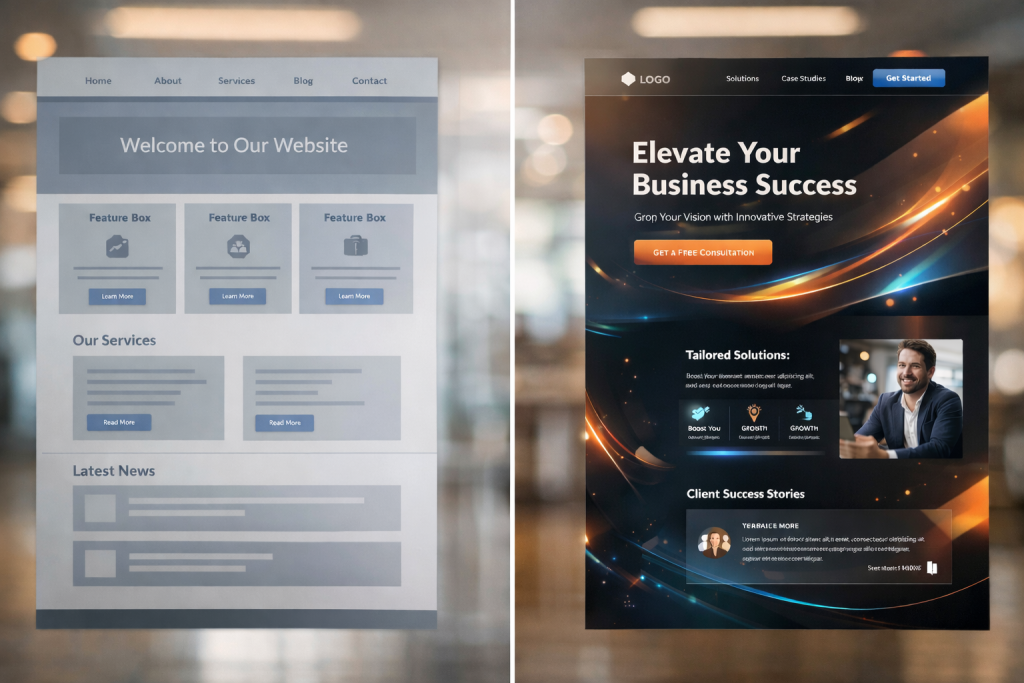
You finally decided it’s time. Time to stop apologizing for your current website and build one that actually brings in business. You start researching, and within minutes, you hit a wall. Do you grab that affordable template and launch by the weekend? Or do you invest in a custom-built site, which sounds great but also sounds expensive? It’s one of the most critical forks in the road for any business owner, and making the wrong turn here can cost you thousands in lost revenue and sleepless nights.
Understanding how to choose between custom and template websites isn’t just about aesthetics; it’s about aligning your digital presence with your growth strategy. To put it simply: a template is like renting a furnished apartment—it’s quick and easy, but you can’t knock down walls. A custom website is like building your dream home—it takes longer and costs more upfront, but every inch is designed for your life.
Quick Answer: Which One Should You Pick?
Choose a template website if you have a strict budget under $2,000, need to launch a basic brochure site or blog in days, and don’t mind potentially looking similar to other businesses in your niche. Choose a custom website if you need to generate significant leads or sales, require unique functionality, want to stand out from competitors, or plan to scale your business and need a site that can handle advanced SEO and high traffic volumes without collapsing .
The Hidden Ceiling of Template Websites
Let’s be clear: templates aren’t “bad.” Platforms like WordPress, Squarespace, and HubSpot offer sophisticated themes that can get a solo entrepreneur online for a few hundred dollars . For a micro-business just testing the waters, this is a valid path.
However, our experience auditing hundreds of small business sites reveals a painful pattern. Business owners hit the “template ceiling.” They start generating traffic, but it won’t convert. They ask for a small feature addition, but the template’s rigid code breaks. They try to optimize for SEO, but the page structure is a mess of bloated code.
Templates are built for the masses. According to industry data, 53% of all web traffic comes from organic search, yet many templates are not architected for the technical rigor required to compete in modern SEO . They often rely heavily on plugins, and here is a terrifying statistic: 96% of WordPress vulnerabilities are related to plugins . That “cheap” site can become a security nightmare.

The Webiyan Framework: The 4-Pillar Scorecard
So, how do you decide? At Webiyan, we don’t just ask “How much money do you have?” We run prospects through our proprietary “Growth & Scalability Scorecard.” This framework analyzes your needs across four critical pillars to determine if a template will suffice or if custom development is the only real answer.
1. Uniqueness & Brand Authority
-
Template Reality: You are renting space in a pre-built design. There are likely thousands of other sites using the exact same layout as yours. In a crowded market, blending in is the enemy of trust .
-
Custom Advantage: We build from a blank canvas. Your color scheme, user flow, and micro-interactions are crafted to imprint your brand in a visitor’s memory. If authority in your niche is critical, custom is non-negotiable.
2. Conversion Architecture
-
Template Reality: Templates design for “pretty.” They place contact forms in the footer and have generic “Learn More” buttons. They aren’t built to sell.
-
Custom Advantage: We design for “clicks.” Every element, from the above-the-fold value proposition to the placement of trust badges, is strategically engineered to guide users toward a specific action (a call, a form fill, a purchase). We don’t just build sites; we build conversion engines.
3. SEO & Performance Ceiling
-
Template Reality: Because templates rely on plugins for sliders, forms, and SEO, they accumulate “code bloat.” This slows down your load speed, which Google punishes. You are capped at a 70-80 PageSpeed score, no matter how hard you try.
-
Custom Advantage: We write clean, minimal code. We implement technical SEO best practices at the server and code level. We can achieve those 95+ PageSpeed scores that keep Google happy and users engaged.
4. Scalability & Integration
-
Template Reality: Trying to connect your template site to a complex CRM, a custom API, or a multi-vendor marketplace is like forcing a square peg into a round hole. It usually breaks.
-
Custom Advantage: Your site is built as an ecosystem. It can grow with you—adding new features, handling ten thousand visitors a day, and integrating seamlessly with your back-end tools without performance loss.
Case Study: How a Custom Approach Unlocked 44% More Conversions
To illustrate the power of a custom, conversion-focused mindset, let’s look at a real-world example that mirrors what we do at Webiyan. We worked with a B2B software company, Tom’s Planner, who was struggling with their existing site.
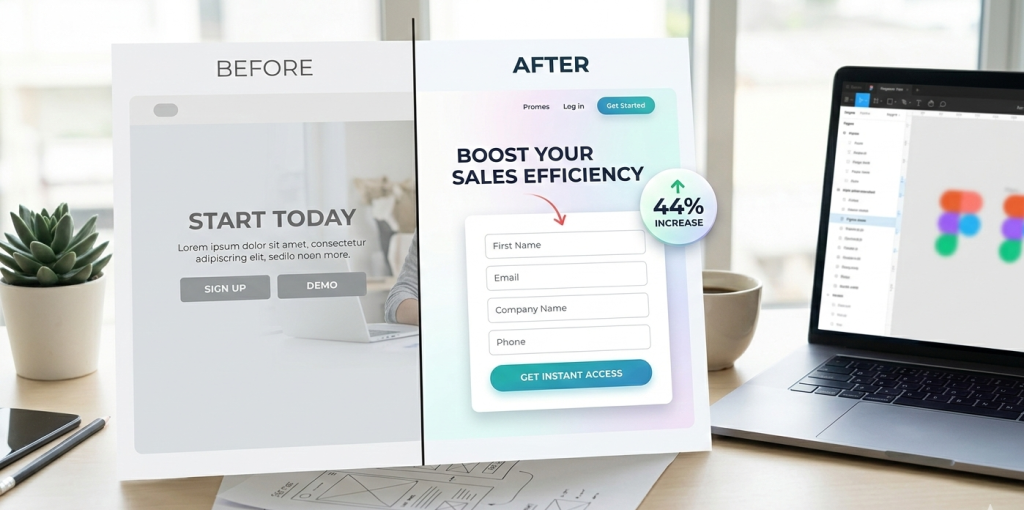
They had a standard setup: two buttons above the fold—one for “Sign Up” and one for “Demo.” It looked fine, but it wasn’t working. Using a custom, data-driven approach (similar to the VWO framework), we hypothesized that visitors were getting confused by the choice .
Instead of just two buttons, we designed a custom layout that placed a short, 4-field sign-up form directly on the homepage, above the fold. We added a simple directional cue (an arrow) pointing to it. The result? A 44% increase in sign-ups .
A template would have forced them to stick to the standard button layout. A custom approach allowed us to restructure the page based on user behavior data, turning passive visitors into active leads. This is the difference between a site that just “exists” and a site that actively performs.
Head-to-Head: Making the Right Choice
To help you visualize the trade-offs, here’s how the two options stack up against the factors that impact your bottom line:
| Feature | Template Website | Custom Website |
|---|---|---|
| Cost | Low ($100 – $2,000 upfront) | High ($5,000 – $50,000+) |
| Time to Launch | Fast (Days to 2 weeks) | Moderate (4 – 12 weeks) |
| Uniqueness | Low – Looks like competitors | High – Exclusively your brand |
| Conversion Focus | Generic layouts, low optimization | Engineered for user journey & sales |
| SEO Capability | Limited by code bloat & plugins | Full control over architecture & speed |
| Security | Risk from third-party plugins | Clean code, harder to breach |
| Scalability | Difficult – often requires rebuild | Built to grow with your business |
The Conversion-Focused Middle Ground
There is a nuance here. Sometimes, a “hybrid” approach is the smartest entry point. At Webiyan, we occasionally start with a high-quality, lightweight theme (to save you money on initial design) but then invest the budget in custom development of high-impact pages.
For instance, we might use a theme for your basic privacy policy and about us pages, but we will custom-code your homepage, service pages, and pricing pages. Why? Because these are your money pages. This is where the “growth engine” lives. We ensure these pages have custom interactive elements, strategic heatmap-driven layouts, and conversion paths that a standard template could never provide.
Your Action Plan: From Decision to Dominance
Still unsure? Here is a simple, actionable path forward:
Define Your “North Star” Metric: What is the one thing you want your website to do? (e.g., “Generate 10 consultation bookings per week” or “Sell 50 units of Product X”). If your goal is passive information, lean template. If your goal is active revenue, lean custom.
Audit Your Current Tech Stack: Are you using (or planning to use) a complex CRM like HubSpot or Salesforce? Do you need a membership portal? Custom sites integrate seamlessly. Templates… don’t .
Consider the Lifetime Value: A $5,000 template site that needs to be replaced in 2 years costs you $2,500/year. A $15,000 custom site that lasts 5+ years costs you $3,000/year but generates significantly more leads.
Run the numbers on the return, not just the cost.Ready to stop guessing and start growing? If you’re serious about building a website that acts as your hardest-working salesperson, let’s talk. We’ll analyze your goals and show you exactly where a custom build will pay for itself in new customer acquisition.
1. Is it possible to switch from a template to a custom website later?
Yes, but it’s not a simple “upgrade.” You cannot easily convert a template site into a custom one. It typically requires a full rebuild from scratch, which means migrating content and redesigning layouts. This is why we recommend planning for the long term now to avoid double costs later .
2. Can a template website ever rank #1 on Google?
Yes, it’s possible for low-competition keywords. However, as competition increases, the technical limitations of templates (slow speed, poor code structure) make it much harder to outrank custom-built sites that are optimized for Core Web Vitals and advanced technical SEO .
3. Are custom websites harder for me to update myself?
Not anymore. As a top web design company for service-based businesses, we build custom sites on user-friendly content management systems (like WordPress or HubSpot). We ensure you have a clean, intuitive backend that’s actually easier to use than a bloated template interface, so you can update text and images without touching a line of code.
4. How much should a small business budget for a professional website?
For a basic template site with minor customization, budget between $1,000 and $3,000. For a professional, conversion-focused custom website from a reputable best web development agency for small businesses, you should expect to invest between $7,500 and $25,000, depending on the complexity and number of pages.
5. What is the biggest mistake business owners make in this decision?
Choosing based solely on the upfront price tag. They save $2,000 on a template but lose $20,000 in missed sales over two years because the site doesn’t convert or rank. Focus on the conversion potential, not just the cost. A cheap website is the most expensive option if it doesn’t bring in business.
Stop Guessing. Let’s Get the Data.
The truth is, you don’t have to navigate this decision alone based on a blog post. The fastest way to get a definitive answer is to put your current website—or your idea—under the microscope.
If you’re tired of wondering why your site isn’t performing, we’ll tell you. Our team will analyze your current traffic, conversion rates, and technical setup. We’ll identify exactly where you’re leaving money on the table and provide a clear roadmap, whether that’s optimizing your existing template or building a custom powerhouse.
Click Here to Request Your Free Website Audit & Strategy Session
Stop settling for a site that just exists. Get the custom strategy you need to dominate your market