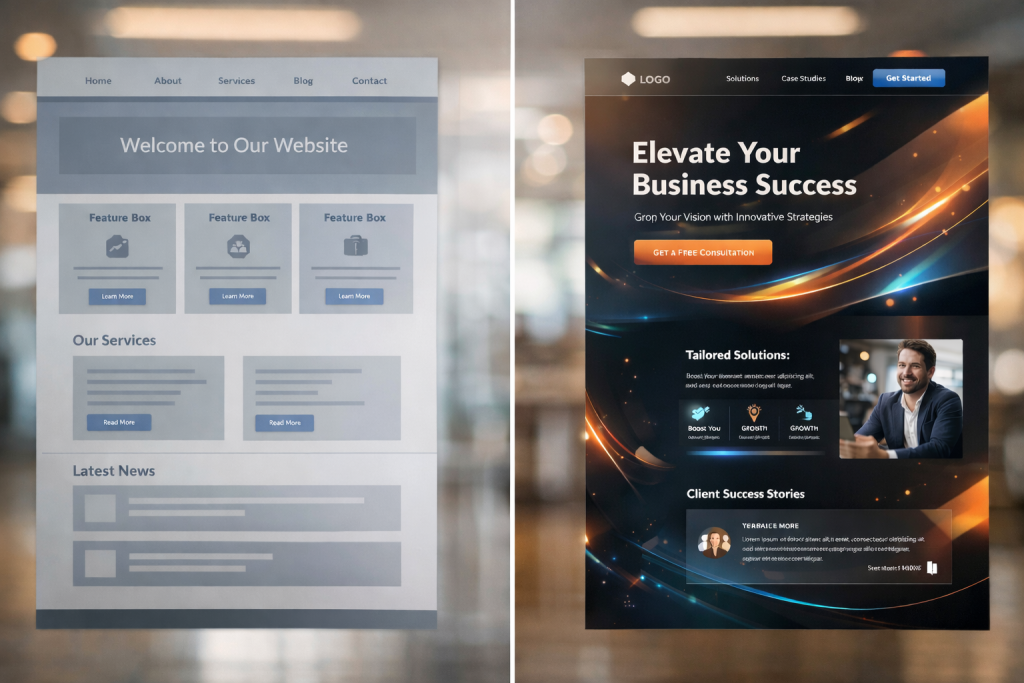
You’ve been putting it off, haven’t you? You know you need a new website, but every time you start researching, you’re hit with a dizzying maze of prices. One site promises a professional site for $500, while another throws around numbers like $50,000. As a business owner, you’re not just looking for a price tag; you’re looking for a return on an investment. You need to know: What is the real cost of a website in 2026, and more importantly, what will actually drive revenue for your business?
Let’s cut through the confusion. In this guide, we’ll break down the pricing trends for small business websites in 2026, revealing where your money should go and where it’s often wasted. We’ll move beyond simple sticker prices to show you how to budget for a site that doesn’t just look pretty, but actively brings in leads.
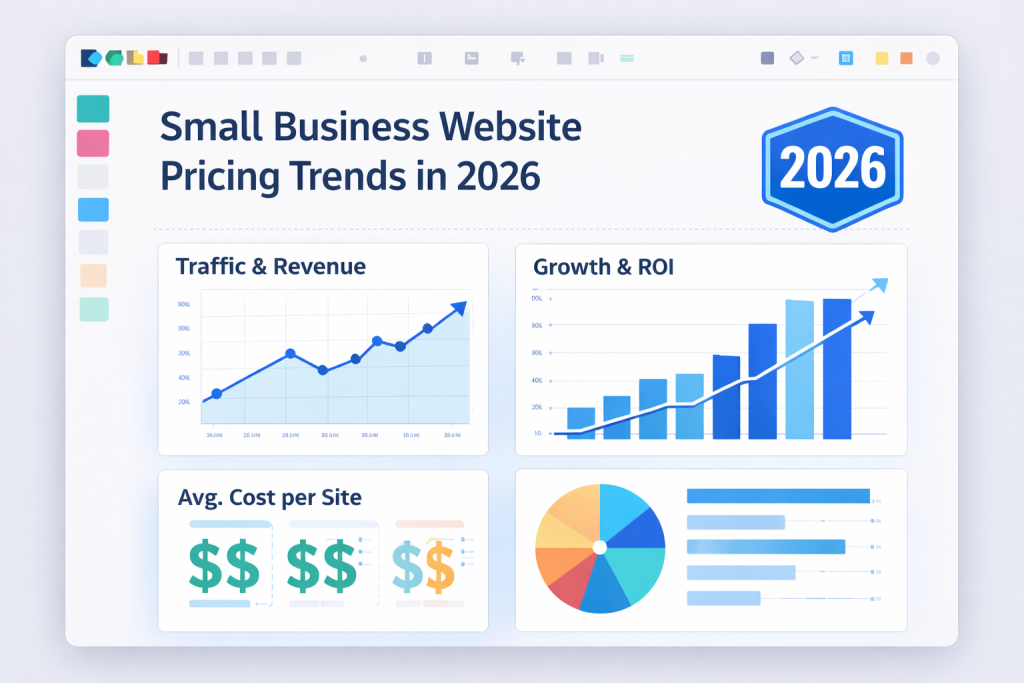
For a small business in 2026, expecting to pay between $8,000 and $35,000 upfront for a professional, agency-built website is realistic . While DIY builders cost as little as $30 a month, they often fail to generate leads. The most significant shift in 2026 pricing isn’t about design, but about building for AI Search (AEO) and seamless performance—factors that directly determine if your site will be found by customers .
The “Good, Better, Best” of 2026 Website Pricing
In our experience working with hundreds of small businesses, the “how much” question is best answered by another question: “What job does this website need to do for you?” Are you validating an idea, establishing a local presence, or building a 24/7 lead-generation engine? Here’s how the market breaks down in 2026.
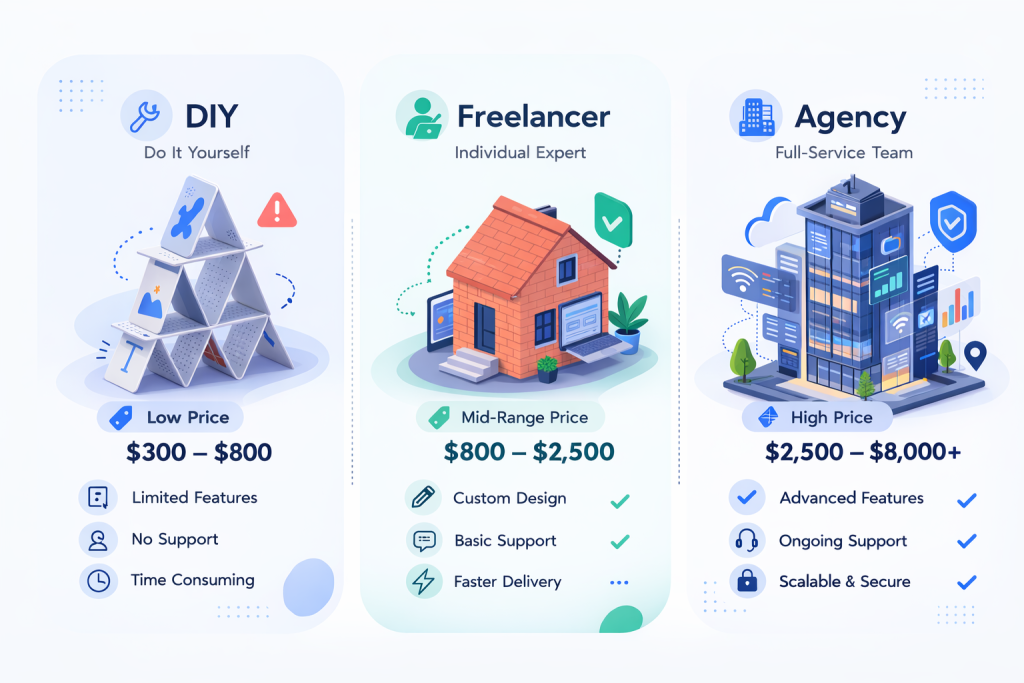
The DIY or Template Route ($500 – $3,000 upfront)
This path includes SaaS builders like Wix or Squarespace, or a basic WordPress theme installed on low-cost hosting . It’s tempting because the barrier to entry is low.
What You Get: A site live in a few days using a pre-built template. You handle the setup, content, and photos.
The 2026 Reality: While costs seem low, the real price is often paid in missed opportunities. These sites frequently lack the technical depth for AI Engine Optimization (AEO) , struggle with site speed, and offer little strategic guidance on turning visitors into customers. You might save money, but you’ll likely burn time and lose leads.
The Freelancer Sweet Spot ($3,000 – $10,000 upfront)
A skilled freelancer can offer a more custom look and feel than a basic template, often working within platforms like WordPress or Webflow.
What You Get: A more unique design, better attention to detail, and a direct line to the person building your site.
The 2026 Reality: This remains a viable option for very small projects. However, the risk is the single point of failure. What happens when the freelancer moves on, gets sick, or isn’t an expert in the SEO and conversion strategy required to make your site profitable after launch? You often get a product, not a performance strategy .
The Agency Standard ($8,000 – $35,000+ upfront) – The 2026 Sweet Spot
This is the tier where a website transforms from a cost center into a revenue asset. An agency brings a team: a strategist, a designer, a developer, and a project manager.
What You Get: A fully custom, conversion-optimized website built on a solid, scalable foundation. This includes deep discovery, UX strategy, custom design, and development that prioritizes speed, security, and search visibility.
The 2026 Reality: This is the fastest-growing segment for serious small businesses . Why? Because the cost of inaction—a site that doesn’t rank, doesn’t convert, and doesn’t last—is far higher than the upfront investment. As one expert noted, the cheapest website is often the one that doesn’t need to be rebuilt in 12 months .
Why 2026 Pricing Is Different: The Rise of the “Digital Business Hub”
In the past, you paid for a design and slapped some text on a page. In 2026, you’re paying for a sophisticated piece of business infrastructure. Three key trends are driving prices—and value—upward.
1. AI Optimization (AEO) Is No Longer Optional
Search is changing. Google and other engines are now heavily reliant on AI to understand and rank content. If your website isn’t structured for AI to read—with proper schema markup, semantic HTML, and clear topical authority—it simply won’t be found . Building this into the foundation of your site requires expertise, not just a plugin.
2. The “Performance Tax” is Real
Visitors expect your site to load instantly. If it doesn’t, they bounce. We see it every day: sites built on cheap hosting or bloated page builders that take 5+ seconds to load. In 2026, high-performance hosting on infrastructure like the Google Cloud Platform, combined with optimized code, is a baseline requirement, not an add-on . This costs more, but the return is lower bounce rates and higher conversions.
3. Experience, Expertise, Authority, and Trust (EEAT) is a Ranking Factor
Google wants to rank sites built by real experts. A generic template with stock photos screams “low authority.” A custom site built by an agency that takes the time to understand your business, showcase your expertise, and build a trustworthy UX directly contributes to your ability to rank .
The Hidden Costs That Blow Your Budget (and How to Avoid Them)
One of the biggest mistakes we see small business owners make is focusing only on the initial build cost. The true cost of a website is its Total Cost of Ownership (TCO). Here’s where money often leaks.
The “Cheap Build” Trap
We recently had a client come to us after spending $6,000 with a freelancer. It looked okay, but it was built on a clunky, outdated system. They were paying $200/month in “maintenance” just to keep the lights on, and they couldn’t make simple text changes without another invoice. They ended up spending $15,000 with us to rebuild it properly. As we often say, buying cheap is the most expensive option.
The Real Cost Breakdown
A smart budget accounts for these three layers:
The Build: Design, copywriting, development, and project management.
The Foundation: Robust hosting, SSL certificates, and security monitoring. Skimping here is like building a beautiful house on a swamp.
The Fuel: Ongoing maintenance, content updates, and SEO. A website isn’t a “set it and forget it” tool; it’s a garden that needs tending to keep growing .
A Smarter Way to Budget: Our Conversion-First Framework
How do we help our clients avoid these pitfalls and ensure their investment pays off? We use a proprietary system we call the “Conversion Architecture Audit.” Instead of starting with “what color should the header be?”, we start with data.
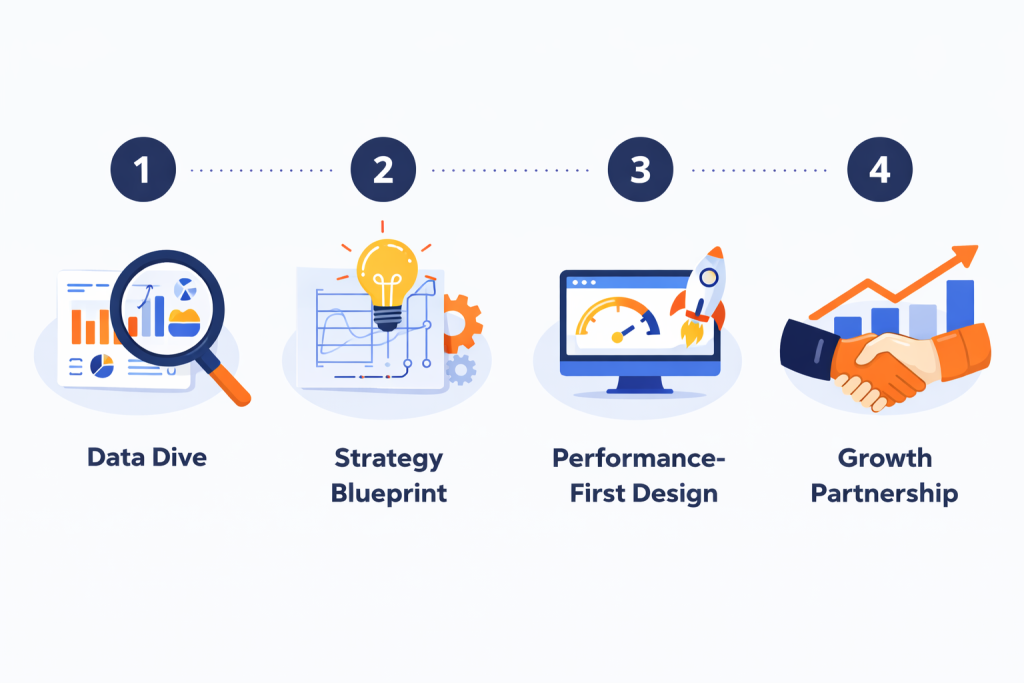
Step 1: The Data Dive. We analyze your current traffic, user behavior, and competitor landscape. We identify exactly where leads are dropping off.
Step 2: The Strategy Blueprint. Before a single pixel is designed, we map out the user journey. We decide on the specific calls-to-action, the information hierarchy, and the technical SEO structure needed to attract and convert your ideal client.
Step 3: Performance-First Design & Development. Only then do we design. We build on a lean, high-performance stack that scores 90+ on Google PageSpeed Insights and is structured for AI search from day one.
Step 4: The Growth Partnership. We launch, but we don’t leave. We provide ongoing analytics reviews and strategic updates to ensure your site continues to perform as your business grows.
Is Your Current Website Costing You Customers?
The Proof: A concrete example makes this real. A regional service provider came to us frustrated. They had spent $22,000 on a “professional” website just two years prior. It looked great, but it was a ghost town. They were getting maybe one or two inquiries a week and were heavily reliant on paid ads to survive.
We ran our Conversion Architecture Audit and found the problem: the site was technically sound but strategically bankrupt. The messaging was all about them (“we are the best”), not about the client’s problems. The calls-to-action were buried. The page load time was over 4 seconds.
After implementing our recommendations—which included a full content rewrite, restructuring the information architecture, and migrating to a high-performance hosting environment—the results were dramatic. Within six months, organic traffic increased by over 265%, and more importantly, qualified inquiries jumped by 162% . Their website finally became the lead-generation machine it was always meant to be.
Website Pricing at a Glance
To help you visualize where different solutions land, here is a comparison based on our 2026 market analysis.
| Feature / Investment Level | DIY Builder (e.g., Wix, Squarespace) | Professional Agency (e.g., Webiyan) |
|---|---|---|
| Typical Upfront Cost | $0 – $500 setup + ~$30/mo | $10,000 – $35,000+ |
| Strategy & UX | Template-based, limited flexibility | Custom research and user-journey mapping |
| Design Uniqueness | One of thousands using the same template | 100% custom, built to convert your audience |
| SEO & AEO Foundation | Basic, on-page tools only | Deep technical setup, schema, and content strategy |
| Performance (Speed) | Dependent on platform, often bloated | Optimized for Core Web Vitals and speed |
| Total Cost of Ownership (3 Years) | ~$1,000 – $2,000 (plus lost revenue) | ~$18,000 – $40,000 (including growth) |
| Primary Outcome | An online presence | A measurable business asset |
Frequently Asked Questions About 2026 Website Pricing
Q: What is a realistic budget for a small business website in 2026?
A: For a professional, custom-built site designed to generate leads, a realistic budget is between $10,000 and $35,000. This covers strategic planning, custom design, development, and a focus on SEO and performance .
Q: Why are some web design quotes so much higher than others?
A: Price differences usually come down to the scope of work and expertise. A low quote often reflects a template-based approach with no strategy. A higher quote from an agency includes discovery, UX design, custom development, project management, and a focus on long-term results like search visibility .
Q: I’m worried about ongoing costs. What should I budget for after the site is built?
A: Smart businesses budget 10-20% of the initial build cost annually for maintenance, hosting, security, and content updates. This ensures your site remains fast, secure, and effective . Neglecting this is like buying a car and never changing the oil.
Q: Can AI website builders replace an agency in 2026?
A: For a simple, one-page site, perhaps. But for a business that relies on its website for leads and sales, no. AI builders lack the strategic thinking, custom UX design, and nuanced brand building that a human-led agency provides. They are a tool, not a strategist .
Your Website Should Be Your Best Salesperson
Your website is no longer just a digital brochure. In 2026, it’s the central hub of your sales and marketing efforts. It works 24/7 to find, inform, and convert your ideal customers. A cheap site isn’t a bargain; it’s a liability that quietly turns away potential business every single day.
You deserve a website that doesn’t just look good, but performs. You deserve a partner who sees the numbers behind the design and cares as much about your ROI as you do.
Ready to build a website that actually generates leads?
Stop guessing and start growing. Let’s have a conversation about your goals and see how our Conversion Architecture Audit can transform your online presence into a powerful business asset.